


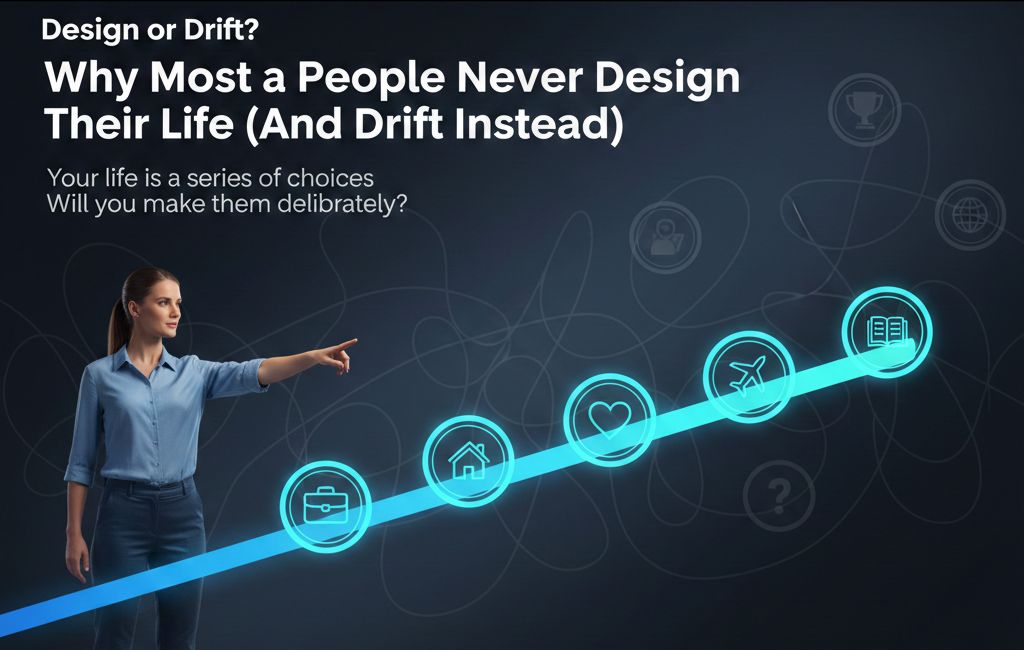
There’s a pattern you see everywhere once you start looking for it. People make decisions—about careers, relationships, where they live, how they spend their time—without ever asking whether those decisions align with what they actually want. They don’t design their lives. They inherit them, absorb them from their surroundings, or let circumstances decide for them. Then they wake up ten years later wondering how they got here.
It’s not laziness. It’s not even a lack of ambition. It’s something more fundamental: most people never learn to think of their life as something they can deliberately shape. The concept feels abstract, maybe even arrogant. Who are we to design our lives when so much is outside our control? And besides, isn’t that what growing up is—following the expected path, doing what’s reasonable, making the responsible choices?
The problem is that “reasonable” choices are often just default choices. And default choices are rarely yours.
The Default Path Has Incredible Gravity
We underestimate how much of life runs on autopilot. You go to school because that’s what kids do. You pick a major based on what sounds practical or interesting at eighteen. You take the job that makes sense given your degree. You date someone who fits into your current life. You buy the house you can afford in the city where you already are. Each decision seems logical in isolation, but the cumulative effect is a life built by inertia rather than intention.
The defaults are powerful because they’re everywhere. They’re in the questions your family asks at dinner, the metrics your friends use to measure success, the timeline society assumes you’re following. They’re reinforced constantly, so they feel like the only reasonable option. Straying from them requires justification. Sticking with them requires nothing.
This isn’t inherently bad. Defaults exist because they work for a lot of people, or at least worked for previous generations. But the moment you accept them without examining whether they work for you, you’ve handed over the design process. You’re letting the culture, your upbringing, or pure circumstance decide what your life looks like.
Drift Feels Safe (Until It Doesn’t)
Drifting is comfortable in the short term. There’s no existential confrontation, no pressure to define what you want when you’re not even sure what that means. You can stay busy, stay productive, stay aligned with what everyone around you is doing. It feels like progress.
The danger is that drift has a delayed cost. You don’t feel it acutely at twenty-five or thirty. You’re still building, still figuring things out. But by thirty-five or forty-five, the weight of accumulated drift becomes harder to ignore. You look at your career and realize you’re good at something you don’t care about. You look at your relationships and see compromise without connection. You look at your days and can’t remember the last time you did something because you genuinely wanted to, not because it was expected or convenient.
At that point, changing course is expensive. You’ve built obligations, dependencies, routines. The gap between where you are and where you wish you were feels enormous. So most people don’t change course. They adjust their expectations instead. They tell themselves this is just how life is—everyone feels this way, right? The dissatisfaction becomes background noise.
Designing a Life Requires Confronting Hard Questions
The reason so few people design their lives is that it’s uncomfortable. It forces you to ask questions that don’t have easy answers. What do I actually value? What trade-offs am I willing to make? What does success look like for me, independent of what it’s supposed to look like?
These aren’t abstract philosophical exercises. They’re practical decisions with real consequences. If you value autonomy over stability, that changes your career path. If you value deep relationships over a wide social circle, that changes how you spend your time. If you value creativity over income potential, that changes everything.
The problem is that most people avoid these questions because the answers might conflict with the life they’re already living. It’s easier to keep moving forward than to stop and ask whether you’re moving in the right direction. And it’s easier to adopt someone else’s definition of a good life than to build your own from scratch.
But avoidance doesn’t make the questions go away. It just guarantees that someone or something else will answer them for you.
Most People Optimize for the Wrong Things
Even when people do make intentional choices, they often optimize for metrics that don’t matter. They chase the job with the best title, the house in the best neighborhood, the relationship that looks good on paper. They mistake external validation for internal satisfaction.
This happens because external metrics are easier to measure. You can see the salary increase, the promotion, the square footage. You can compare yourself to others and know where you stand. Internal metrics—fulfillment, alignment, peace—are fuzzier. They’re subjective, hard to quantify, and don’t translate into status.
So people spend decades optimizing for things that were never going to make them happy, then feel confused when achievement doesn’t deliver the satisfaction they expected. The design was flawed from the start because the goals were borrowed, not chosen.
Constraints Are Real, But They’re Not Absolute
The counterargument to all of this is obvious: life isn’t a blank canvas. We have obligations, limitations, circumstances we didn’t choose. Not everyone has the luxury of designing their life.
That’s true. But it’s also not the full picture. Constraints are real, but most people overestimate how binding they are. They assume their current job is the only option, their current city is permanent, their current lifestyle is fixed. They treat choices made five years ago as immutable, even when the circumstances that drove those choices have changed.
Designing your life doesn’t mean ignoring constraints. It means working within them intentionally. It means asking: given what I can control, what would I choose? It means distinguishing between the constraints that are genuinely fixed and the ones that just feel that way because changing them is hard.
Most people never ask these questions. They treat their entire life as a constraint and wonder why it feels so limiting.
The Alternative Is Simpler Than It Sounds
Designing your life doesn’t require a dramatic upheaval or a perfectly articulated vision. It starts with smaller, more practical steps. It means pausing periodically to ask whether the direction you’re heading still makes sense. It means being honest about what’s working and what isn’t. It means making decisions based on your priorities rather than default assumptions.
It means building the habit of reflection—not endless navel-gazing, but genuine assessment of whether your daily reality aligns with what you care about. And when it doesn’t, making adjustments. Small ones, usually. Sometimes big ones.
The people who do this well aren’t necessarily happier or more successful in conventional terms. But they tend to feel more ownership over their lives. They understand why they’re doing what they’re doing, even when it’s hard. They’ve traded the comfort of drift for the clarity of intention.
Drift Is a Choice Too
Here’s the uncomfortable truth: not designing your life is still a design choice. It’s choosing to let circumstances, defaults, and other people’s expectations shape your trajectory. It’s choosing to optimize for ease in the short term at the cost of alignment in the long term.
That’s fine if it’s a conscious choice. But for most people, it’s not. It’s the path of least resistance, dressed up as inevitability.
The alternative requires work. It requires thinking clearly about what you want, making trade-offs, tolerating uncertainty, and accepting that your choices might not make sense to others. It requires periodic recalibration because what you want at thirty isn’t what you’ll want at forty-five.
But the cost of not doing that work is higher. It’s a life that feels like it happened to you rather than one you built. It’s looking back and realizing you spent decades serving a plan you never agreed to.
Most people drift because designing feels too hard, too uncertain, too self-indulgent. But drifting is hard too. It just distributes the difficulty differently—less upfront discomfort, more long-term regret.
The question isn’t whether you’ll face difficulty. It’s which kind you’re willing to live with.